
What Is a Jury Consultant? Role, Value & Cost
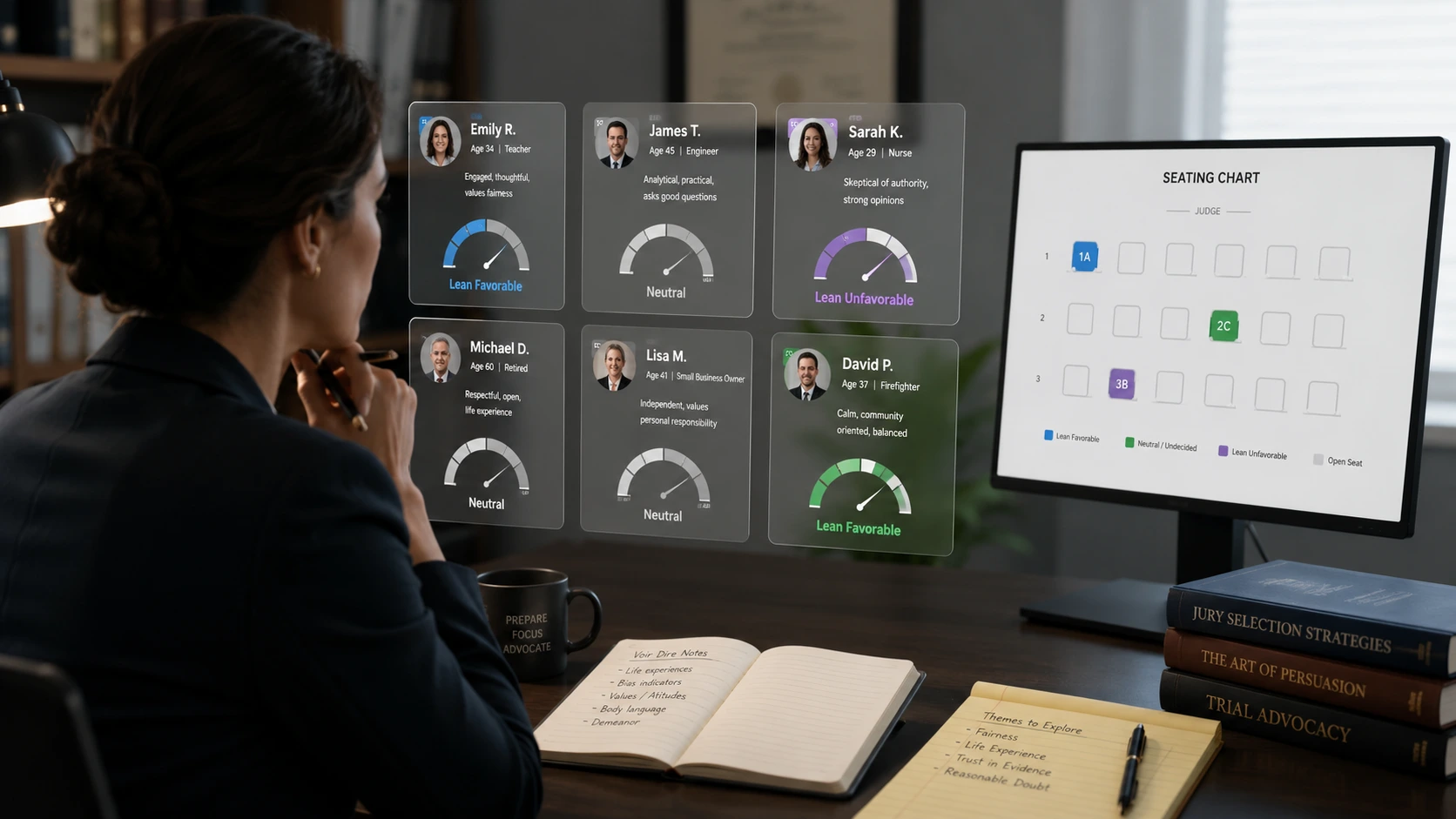
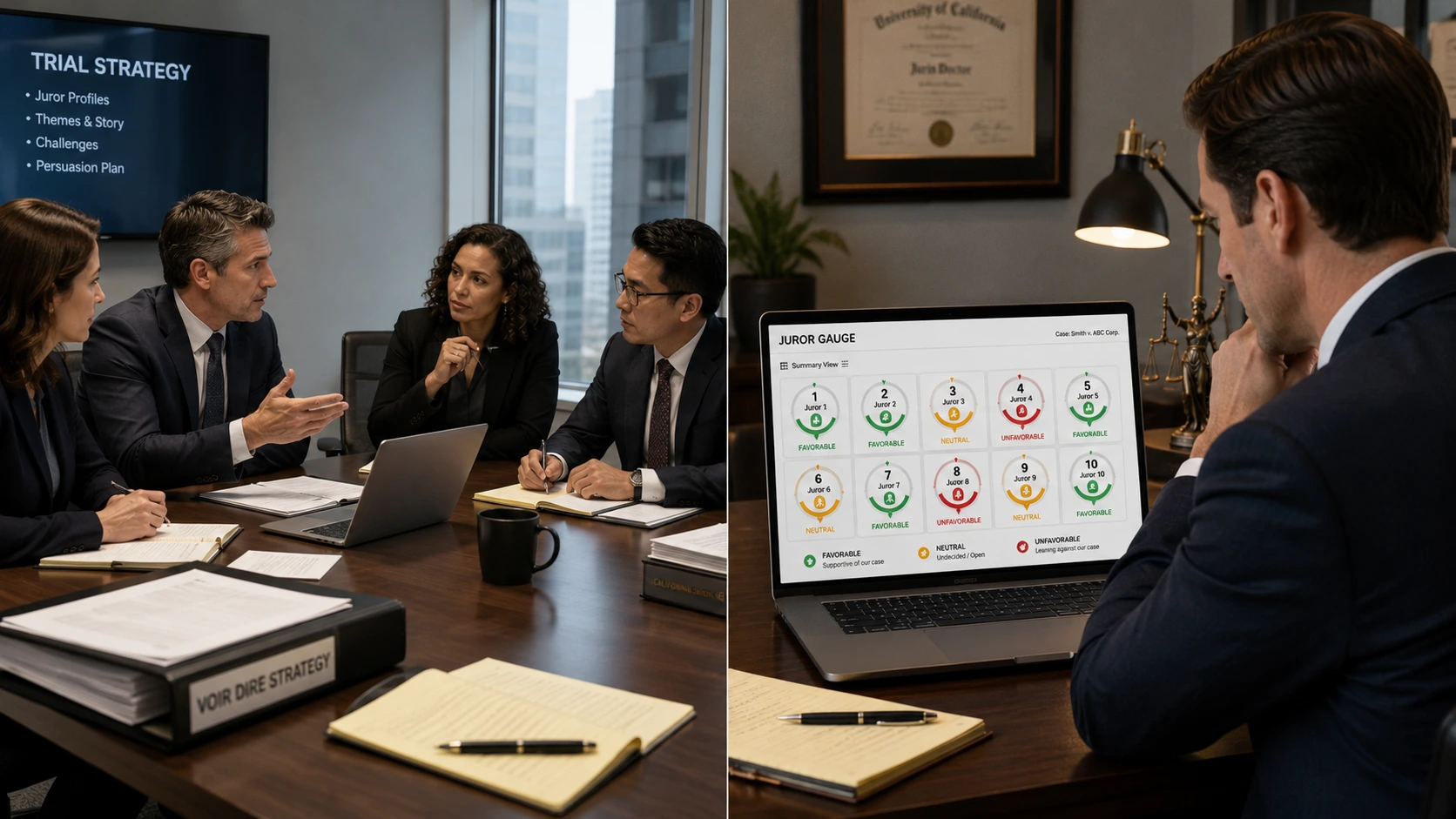
A jury consultant weighs scored juror profiles against a courtroom seating chart.
A jury consultant is a trained behavioral specialist — often with a background in psychology, sociology, or communication — who helps trial attorneys select favorable jurors and shape persuasive case themes. They run mock trials and focus groups, draft voir dire questions, profile prospective jurors, and advise on strikes, all to reduce the guesswork in jury selection.
For most of a trial lawyer's career, jury selection runs on instinct. You read a stranger's posture, parse a two-word answer, and decide in seconds whether that person helps or hurts your client. A jury consultant exists to replace some of that instinct with method.
The work goes by several names — trial consultant, litigation consultant, even "trial scientist" — and the labels overlap. What unites them is a single premise: how a jury decides a case is not random, and the patterns can be studied. This guide explains what a jury consultant actually does, the science behind it, when one is worth the cost, and the lower-cost alternatives that now do part of the same job.
Key takeaways
- A jury consultant applies behavioral science — psychology, sociology, communication research — to jury selection and trial strategy.
- Core services: mock trials, focus groups, voir dire question design, juror profiling, and post-trial interviews.
- Most hold advanced degrees (Ph.D. or J.D.) and many belong to the American Society of Trial Consultants.
- They typically cost $5,000–$25,000 per trial, which is why firms reserve them for high-stakes cases.
- Jury selection software now automates the online-research piece for a flat monthly fee, putting juror analysis within reach for every case.
What does a jury consultant do?
A jury consultant's job is to make jury selection and trial presentation evidence-based instead of intuitive. The work falls into a handful of recurring services.
Pre-trial jury research. Before trial, consultants run mock trials and focus groups — recruiting surrogate jurors who resemble the expected venire, presenting both sides of the case, and watching how they deliberate. The output is a read on which arguments land, which witnesses are credible, and what kind of juror leans toward which verdict.
Voir dire support. Consultants draft juror questionnaires and voir dire topics designed to surface bias quickly, since attorneys often get only a few minutes per panel. In Florida, the scope of that questioning is governed by Florida Rule of Civil Procedure 1.431, and juror qualifications by Florida Statutes Chapter 40.
Juror profiling. Using demographics, attitudes, and increasingly online and public-records data, consultants build profiles of prospective jurors and recommend which to strike for cause or with a peremptory challenge.
Trial strategy and theme development. Beyond selection, consultants help shape opening statements, closing arguments, witness preparation, and demonstrative exhibits so the case narrative matches what their research says jurors actually respond to.
Post-trial work. After a verdict, consultants conduct juror interviews to learn what drove the decision — feedback that informs appeals, retrials, and the firm's next case.
A jury consultant is, in effect, an applied social scientist embedded in your trial team — turning human behavior into something you can plan around.
The science behind jury consulting
Jury consulting grew out of social science research, and "trial science" is the umbrella term for the methods involved. The discipline draws on:
- Psychology and forensic psychology — how attitudes, prior experiences, and implicit bias shape the way a juror weighs evidence.
- Sociology and demographics — how community attitudes and group dynamics influence deliberation.
- Communication and persuasion research — what makes a narrative credible and memorable to a lay audience.
- Statistics and survey methodology — how to design mock-jury studies that produce reliable, not anecdotal, results.
A "trial scientist" is simply a consultant who leans hard on the empirical side, running structured simulations, collecting data, and reporting findings the way a researcher would. The credibility of the field rests on that rigor. Done well, it replaces stereotype with measured behavior; done poorly, it dresses up the same old guesswork in scientific language, which is why courts and commentators scrutinize the methodology behind any juror-scoring claim.
What qualifications does a jury consultant have?
There's no license to practice as a jury consultant, but the credible ones share a profile.
| Credential | Why it matters |
|---|---|
| Advanced degree (Ph.D. or master's in psychology, sociology, or communication; sometimes a J.D.) | Grounds the methodology in real behavioral science |
| Trial or litigation experience | Knows what actually happens in a courtroom, not just a lab |
| Membership in the [American Society of Trial Consultants](http://www.astcweb.org/) | Signals adherence to professional and ethical standards |
| Track record of mock trials / verdict research | Demonstrates the work produces usable predictions |
Many entered through forensic psychology or behavioral science and built case experience over years. The strongest combine an understanding of human behavior with the ability to synthesize messy data into a clear recommendation a trial team can act on under deadline.
When is a jury consultant worth it?
A consultant is worth it when the stakes justify the spend and the case turns on juror attitudes rather than on a clear-cut factual or legal question.
Strong fits:
- High-stakes civil litigation — large damages exposure, where a single juror's bias can swing a verdict by millions.
- Emotionally charged criminal defense — cases where community attitude and pretrial publicity matter.
- Cases with a clear attitudinal split — medical malpractice (distrust of doctors), product liability, employment disputes.
- Venue or change-of-venue questions — where community attitude surveys inform strategy.
Weaker fits are smaller matters where a $12,000 consultant fee dwarfs the amount in controversy. That gap — wanting professional juror analysis but not being able to justify the per-trial cost on routine cases — is the central problem in this field, and it's exactly what drives firms toward jury selection software as a year-round substitute for the online-research portion of the work.
How much does a jury consultant cost?
Most jury consultants charge $5,000–$25,000 per trial, and high-profile engagements can exceed $100,000.
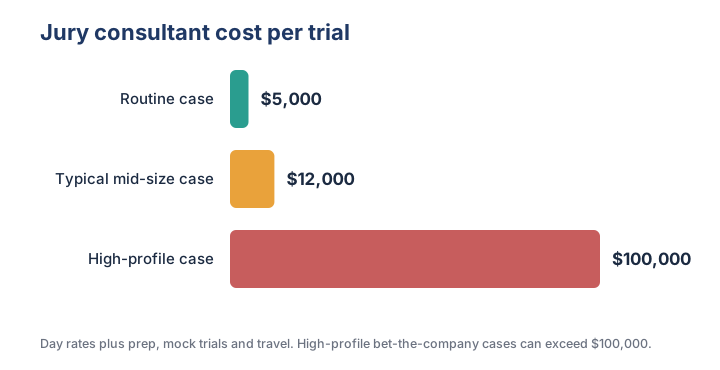
Day rates run roughly $3,500–$7,500, and voir dire support alone is usually one to two days. A full mock trial — recruiting surrogate jurors, facilitating, and reporting — drives the total higher, plus travel and expenses. Because it's priced per engagement, the cost recurs with every trial.
We break the numbers down in detail, including the per-trial-versus-subscription math, in How much does a jury consultant cost?. The short version: for firms trying cases regularly, the per-trial model gets expensive fast, which is why many now weigh jury consultant alternatives before booking one.
Jury consultant vs. software: the modern split
The traditional consultant and the new software tools aren't really competitors — they overlap on one task and diverge everywhere else.
| Jury consultant | Jury selection software | |
|---|---|---|
| Mock trials & focus groups | Yes — core service | No |
| Trial theme & witness prep | Yes | No |
| Online juror research / profiling | Yes, manually | Yes, automated |
| Real-time scoring during voir dire | Limited | Yes |
| Cost model | $5,000–$25,000 per trial | Flat monthly subscription |
| Coverage | The cases you can afford | Every case |
A consultant gives you human judgment, mock-trial data, and strategic counsel — things software can't replicate. Software gives you fast, standardized, online juror research on every trial, not just the expensive ones. Many firms now use both: software to handle the routine research at scale, a consultant for the bet-the-company cases.
For a deeper comparison of the firm side of this, see Trial Consulting Firms vs. Software and Jury Research Services.
Where PeerProbe fits
PeerProbe automates the part of a jury consultant's work that scales: the online juror research. It compiles social media insights, voter registration and political affiliation, court case history, and neighborhood demographics into a single Juror Bias Score™ — a 1–10 rating for every juror in your pool, calibrated to your case type and delivered in real time during voir dire. It uses only publicly available information and is built around Florida's county-by-county public-records rules. It doesn't run your mock trial, but it does deliver consultant-grade juror data on every case for a flat monthly fee.
Frequently asked questions
What is a jury consultant?
A jury consultant is a behavioral specialist who helps trial attorneys select favorable jurors and build persuasive case themes. They run mock trials and focus groups, design voir dire questions, profile prospective jurors, advise on strikes, and conduct post-trial interviews, applying psychology and social-science research to jury selection and trial strategy.
What's the difference between a jury consultant and a trial consultant?
The terms are largely interchangeable. "Trial consultant" and "litigation consultant" tend to describe a broader role that includes witness preparation, demonstrative exhibits, and overall case strategy, while "jury consultant" emphasizes the jury-selection and juror-research piece. Many professionals do both.
How much does a jury consultant cost?
Typically $5,000–$25,000 per trial, with day rates around $3,500–$7,500 and high-profile cases exceeding $100,000. Because it's billed per engagement, the cost recurs every trial, which is why firms usually reserve consultants for high-stakes matters.
Do you need a degree to be a jury consultant?
There's no required license, but credible consultants usually hold an advanced degree in psychology, sociology, communication, or law, and many belong to the American Society of Trial Consultants. Trial or litigation experience and a track record of mock-trial research matter as much as the credential.
Can software replace a jury consultant?
For the online juror-research and scoring portion, largely yes — at a fraction of the cost and on every case. Software cannot replace mock trials, focus groups, or the strategic judgment a consultant brings to a major trial. Many firms use software for routine cases and a consultant for bet-the-company litigation.
Conclusion
A jury consultant brings behavioral science to a process most lawyers run on instinct, and for high-stakes trials that judgment can be decisive. The catch has always been cost: at $5,000–$25,000 per trial, professional juror analysis stays out of reach for most cases. Software closes that gap on the research side, putting consultant-grade juror data on every trial. The right move depends on the case in front of you. The point is that doing nothing is no longer the only affordable option.
See how PeerProbe scores every juror in your pool →
Sources: Florida Rule of Civil Procedure 1.431 (jury / voir dire); Florida Statutes Chapter 40 (jurors); Rules Regulating The Florida Bar; American Society of Trial Consultants (astcweb.org); American Bar Association formal opinions on juror research. Verify all URLs and current rule text before publication.
Frequently Asked Questions
Related articles
How Much Does a Jury Consultant Cost?
A jury consultant costs $5,000–$25,000 per trial, sometimes $100k+. See the full cost breakdown, what drives it, and the per-trial vs subscription math.
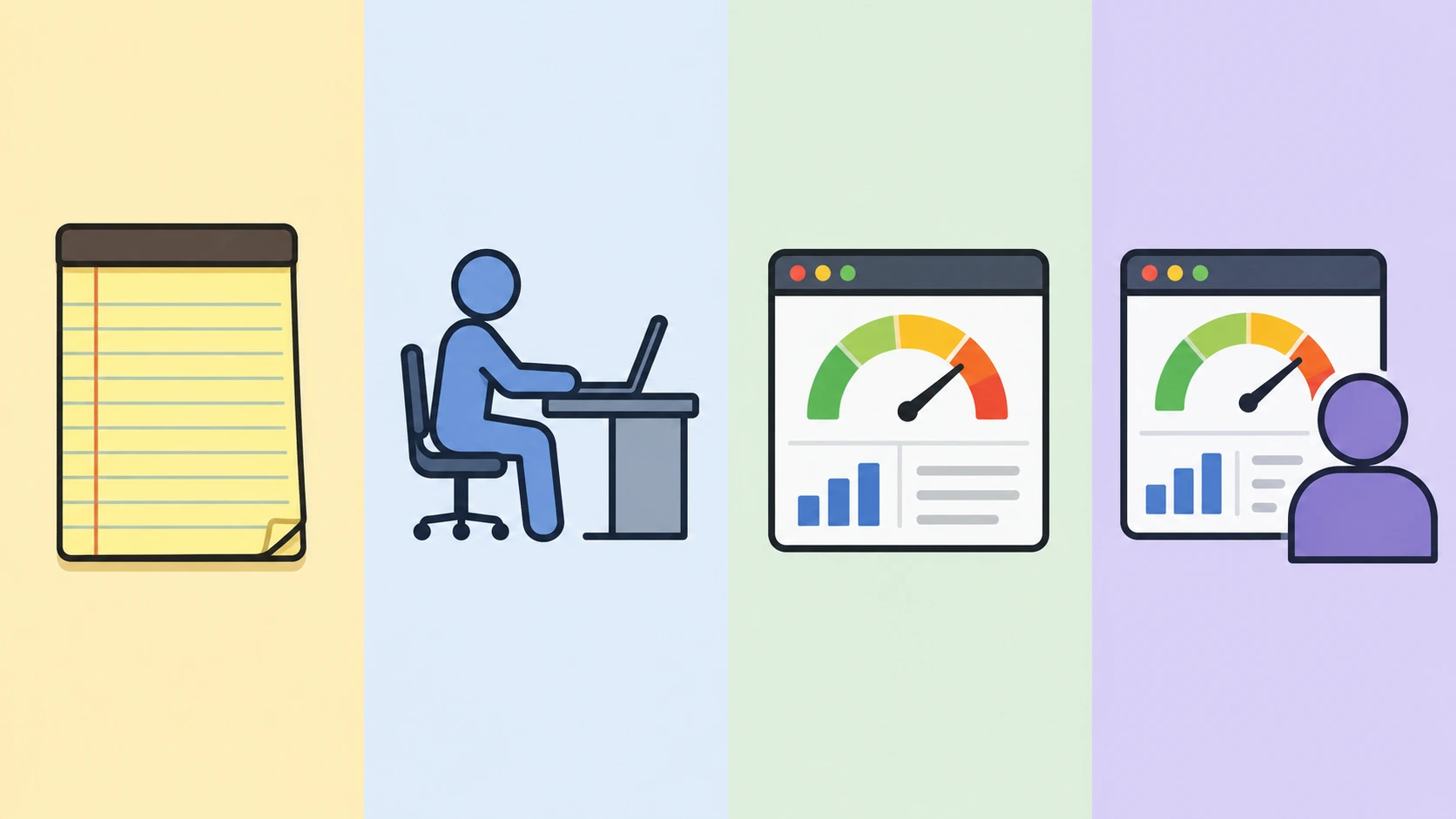
Jury Consultant Alternatives for Modern Trial Teams
Jury consultant alternatives include DIY research, paralegal research, jury selection software, and hybrid models. Compare the pros, cons, and cost of each.
Trial Consulting Firms vs. Software: How to Choose
Trial consulting firms offer jury research, witness prep, and trial strategy. See what they do, what they cost, and when software does the job for less.
See how PeerProbe handles ethical juror research
PeerProbe conducts only ethics-compliant, passive juror research — and documents everything for your file.
Request a Demo